
The Truth About Sales Professionals and Their Pay
When you hear the word "salesman," what comes to mind? For many people, it brings up a specific image. Maybe you think of someone working at a car dealership. You might think about car salesman commission and how it creates an unstable income from month to month.
But in 2026, the reality of a sales career is much bigger than that old stereotype. A salesperson today can hold many different titles. You could be a Sales Development Representative (SDR) finding new leads. You could be an Account Executive (AE) closing big contracts. Or you could be a VP of Sales running an entire team.

These roles each require very different skills and offer different pay.
Experts explain that understanding these distinct roles is crucial for anyone looking to build a career in sales. The old term "salesman" just does not fit anymore. The work is more specialized now.
This matters because how you get paid affects your lifestyle. Some roles offer a steady base salary with a small bonus. Others rely heavily on commission. Your compensation structure directly affects your career choices and how you perform every day.
If you want to know what different sales roles pay in 2026, take a look at our breakdown of sales enablement salary benchmarks for 2026 and how to earn more.
Want to keep learning? Check out our full library of articles for more insights on building your sales career.
Who Is a Salesman? Defining the Modern Sales Professional
The word "salesman" feels like a word from a different time. It might make you think of a specific person working on a car lot, worrying about car salesman commission. But in 2026, this term does not cover the wide range of professionals working in sales today.
The truth is, the industry has evolved. Modern sales teams are built with many specialized roles. You have Sales Development Representatives (SDRs), Business Development Representatives (BDRs), Account Executives (AEs), and Account Managers (AMs). Each title comes with its own focus and skill set. Understanding these different sales roles is key to finding your place in the field.
Despite the different titles, the core mission of a salesperson remains the same. That mission is to find potential customers, build relationships, and close deals. Whether you are a BDR finding new leads or an AE closing large contracts, these core duties are what tie the profession together. The specialists at Bearworks explain that BDRs and SDRs are the engines that drive the initial stages of the sales process, while AEs focus on closing.
There is another important reason the word "salesman" is fading. It is not an inclusive term. Today, people of all genders work in sales. Using "salesperson" or "sales professional" is more accurate and welcoming. Even the word "sales associate," often used in retail, is a step toward more modern, descriptive job titles.
If you are exploring a career as a salesperson, you might want to look at a specific path. The role of a modern sales associate is a great starting point for many. You can read our full breakdown of the duties and skills needed for a sales associate role.
Not sure where you fit in? Contact us for guidance on the best training and resources to level up your sales closing skills and define your own career path.
Common Sales Roles and Titles
Now that you understand the modern sales team is not just one type of "salesman," let’s break down the main roles you will see in 2026. Each has a specific job that helps the whole team win.
Here is a quick look at the most common roles:
- Sales Development Representative (SDR): SDRs focus on outbound prospecting. They find new leads and start conversations. Think of them as the ones who fill the top of the funnel. They do a lot of cold calling and emailing.
- Business Development Representative (BDR): BDRs overlap with SDRs but often target specific accounts or strategic markets. Both roles are described as the engines that drive the initial stages of the sales process, according to Bearworks.
- Account Executive (AE): AEs handle the full sales cycle. They take the leads SDRs and BDRs find and work to close the deal. Their main job is presenting solutions and negotiating contracts. The team at SURFE explains that AEs are different from SDRs because they focus on closing rather than prospecting.
- Account Manager (AM): Once a deal is closed, the AM takes over. They build long-term relationships with customers and look for ways to grow the account over time.
These roles work together like a relay race. The SDR or BDR passes the baton to the AE, and then the AM keeps it going.

Not sure which role might be a good fit for your skills? You can explore our full library of guides to learn more about each career path.
Salesman vs. Salesperson: The Language Shift
You might still hear the word "salesman" used in everyday talk, especially when thinking of a car salesman or a sales associate at a store. But in 2026, most smart businesses have dropped that term. Why? Because words matter.
Using "salesperson" or a specific title like Account Executive shows the job is open to anyone, regardless of gender. It is a small change that makes a big difference in attracting talented people from all backgrounds. Studies show that using gender-neutral language changes how people see your company and its professionalism.
When you call someone a "salesman," you might accidentally picture an outdated stereotype. Calling that same person a "salesperson" or "sales professional" sounds modern and respectful. This shift also helps if you are looking to advance your career. If you want to learn more about moving up, check out our guide on the sales assistant role to see how titles relate to growth.
The language you use reflects your team’s values. Choosing inclusive terms is a simple step toward building a stronger, more welcoming sales culture.
Want more insights like this? Browse our full library of articles to keep learning.
How Sales Professionals Get Paid: Compensation Models Explained
Now that we have cleared up the language around sales roles, let’s talk about the part that really matters: the paycheck. How a salesperson or a sales associate gets paid can look very different depending on the industry and the company. Understanding the options helps you choose the right career path.
The most common compensation model in 2026 is salary plus commission. You get a steady base paycheck every month, and then you earn extra money for each deal you close.

That extra part, the commission, typically lands between 5% and 15% of the sale value. For software sales (SaaS), it often reaches around 12% [Apollo.io].

Some sources say the range can be even wider, from 20% to 30% for certain sales representatives [Mailshake]. The base salary gives you security, and the commission rewards your hustle.
Pure commission plans still exist, too. You might see these in real estate or car sales. A car salesman commission, for example, is often 100% variable. You earn nothing until you sell a vehicle. That model offers huge upside but also real risk. According to the latest data, the median base salary for a general sales representative in the U.S. is $63,230, with the top earners making over $93,000 [Everstage].
So a salary-plus-commission plan gives you a floor to stand on.
Your quota structure determines exactly how much commission you take home. A quota is your sales target. Hit it, and you unlock higher commission rates. Miss it, and you might only get your base pay. Many reps use CRM tools to track progress. If you want to understand what you could earn at different levels, our guide on sales enablement salary benchmarks for 2026 breaks down pay by role and experience.
Whether you prefer the safety of a base salary or the adrenaline of pure commission, there is a compensation model built for you. The key is knowing your own financial needs and risk tolerance.
Want to learn more about career paths in sales? View our full library of articles for practical advice to grow your income.
Base Salary vs. Commission
A base salary is your guaranteed income. You get it every month no matter what. That stability matters when you need to cover rent or groceries. A commission, on the other hand, is extra money you earn when you close a deal. It rewards your performance.
The mix of base salary and commission changes by industry and seniority. A junior sales associate might get a high base with small commissions. A senior salesperson or a car salesman may work on low base and high commission. According to Apollo.io, SaaS commissions average 12% [Apollo.io]. Mailshake reports that 20-30% is typical for many sales representatives [Mailshake].

The median base salary for U.S. sales reps is $63,230 [Everstage].
In short, base salary offers security. Commission offers upside. Choose based on your risk comfort.
Want to compare earning potential? Read our sales enablement salary benchmarks for 2026. Then contact us for training tips to raise your income.
Bonus Structures and SPIFFs
Beyond base salary and commission, many salespeople earn extra through bonuses and SPIFFs. A bonus typically rewards you for exceeding your quota. Hit 120% of your target? You might get a lump sum. This pushes you to go further.
A SPIFF (Sales Performance Incentive Fund) is different. It’s a short-term reward for a specific behavior. Maybe your company offers $200 for every new demo booked this week. Or a car salesman gets extra cash for moving old inventory. SPIFFs focus attention fast.
These incentives can boost morale and drive results. But there is a downside. Some sales associates learn to game the system. They focus only on the SPIFF activity and ignore long-term customer fit. As the Sales Compensation Plans guide notes, a balanced plan prevents this.
The best salespeople use bonuses and SPIFFs as extra fuel, not their main strategy. Want to build skills that actually earn those bonuses? Check out our article on soft skills training that boosts sales performance. Then contact us for training recommendations tailored to your goals.
Residuals and Recurring Commissions
Think about a car salesman commission. You sell a car, you get paid once. Done. But what if you got paid every month that customer kept driving it? That is the idea behind residual commissions.
This model is common in subscription businesses like Software as a Service (SaaS). You close a deal for a monthly software plan. Your company pays you a small percentage of that recurring revenue each month. As long as the client stays, you keep earning. This creates a steady income stream. According to industry data from 2026, SaaS commission rates often reach around 12%, reflecting that ongoing value.
The upside is huge. A salesperson who builds a strong book of business can earn passive-like income over time. The challenge? You must focus on client retention. If your customer churns (cancels), your commission stops. This means you need good relationship skills and follow-up habits. Tools that help manage client accounts, like the top CRM software for sales growth in 2026, can make retention easier.
Ready to build skills that support a recurring revenue sales career? Contact us to explore training that helps you close clients who stick around.
Average Sales Compensation by Role and Industry in 2026
We just covered how recurring commissions can create steady income. But what does a typical salesperson actually earn in 2026? The numbers vary a lot based on your role and the industry you work in.
For entry-level roles, the base pay is solid. Most sales development representatives (SDRs) earn between $50,000 and $65,000 in base salary. According to industry compensation data, the median base salary for a general sales rep is around $63,230.
Now, move up to an account executive (AE). The base salary for that role jumps to $80,000 to $150,000 or more. That is a big leap. But the real difference comes from the industry. Tech and pharmaceutical sales pay above average. These fields reward skilled salespeople with higher commissions because the products are complex and valuable. A talented salesman in tech can earn much more than someone selling simpler goods. A 2026 guide on B2B commission rates explains that most roles combine a stable base with variable commission. This gives you the chance for high total earnings if you perform well.
If you are aiming for the top, look at tech or pharma. Many sales associates start as SDRs in these industries and later move into AE roles. With the right training and strategy, you can build a career with serious earning power.
Want to learn more about advancing your sales career in high-paying industries? Read our full guide on finding the right sales job to get started. And when you are ready to level up your skills, browse more articles for training tips that work.
Key Factors That Influence a Salesperson’s Earnings
So you know the average pay by role and industry. But here is the thing. Two salespeople in the same role at the same company can earn very different amounts. Why? A few powerful factors decide your paycheck.
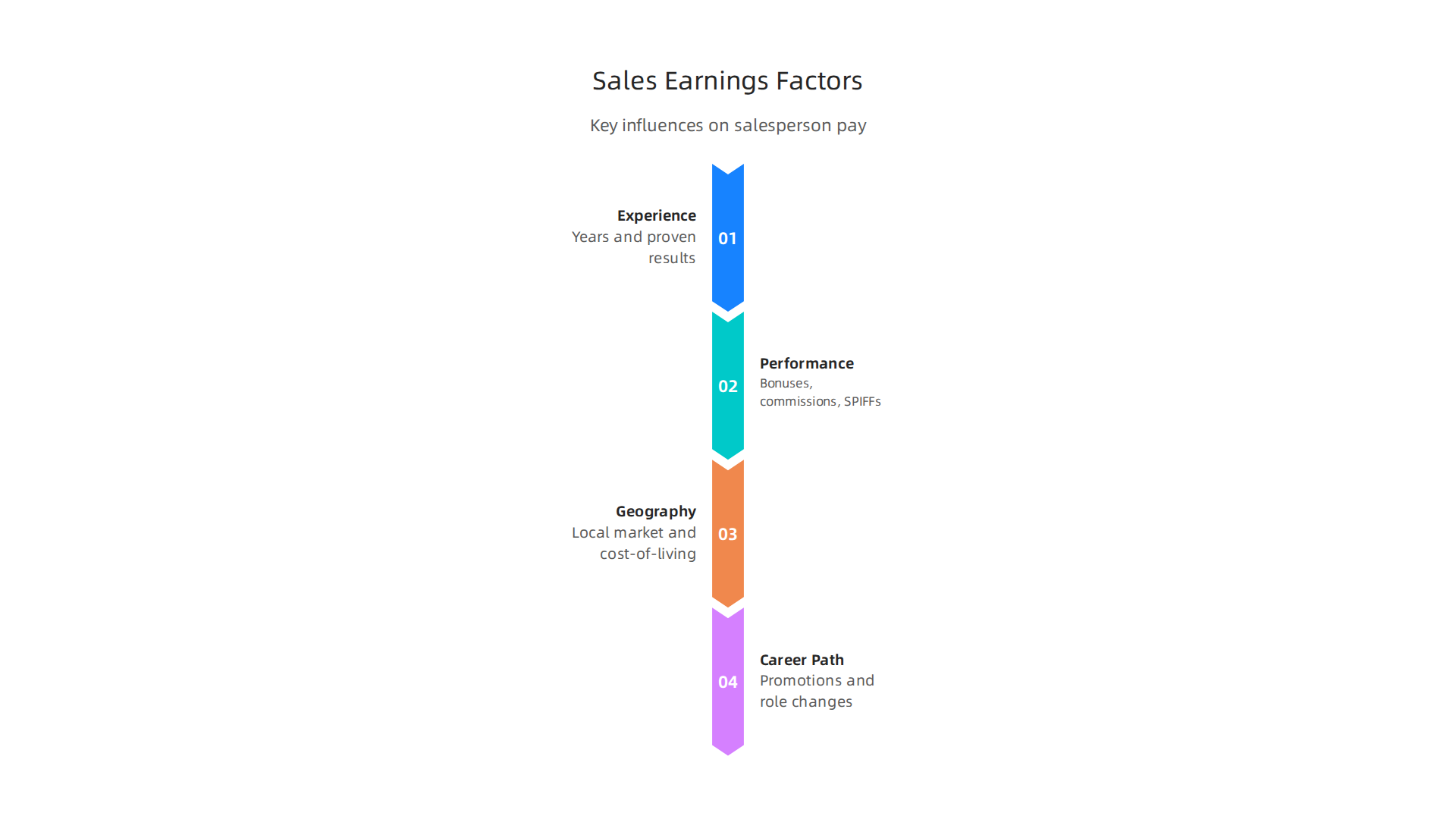
Experience and track record matter most. Your past results speak louder than anything else. A salesman with five years of proven wins will always command a higher base salary and better commission structure than a beginner. According to 2026 compensation data, companies use past quota attainment to set your pay. If you have a strong history of hitting targets, you have leverage. This is why building a solid track record early in your career pays off for decades.
Performance incentives also play a big role. A 2026 study on sales incentives shows that top performers earn significantly more through bonuses and SPIFFs tied to their results. So your income grows as you prove yourself.
Geography changes everything. Where you live directly affects how much you take home. A salesperson in San Francisco or New York earns a higher base salary than someone in a smaller city. This is not because they work harder. It is because the cost of living is higher there. Companies adjust pay to match local markets. A 2026 compensation trends guide explains that salary variations by region can be 30% or more. The same sales role in a low-cost area might pay $60,000 while the same job in a high-cost area pays $80,000.
This means you should think about where you want to work. Moving to a city with a higher pay range can boost your earnings immediately.
Your career path also matters. Many sales associates start in an SDR role and then move up to become account executives. Each step increases your earning potential. If you want to grow your income, you need a clear plan for advancement.
Want to see how different roles stack up? Read our guide on sales enablement salary benchmarks for 2026 to compare roles and find your best path forward. And when you are ready to put these insights into action, check out more articles that help you close bigger deals and earn more.
The Pros and Cons of Commission Based Income
Commission based pay is a big reason many people choose sales. It can make your income soar. But it also comes with real downsides. Let’s look at both sides so you can decide if this path is right for you.
The Good: High Earning Potential and Control
The biggest draw of commission is uncapped earning potential. Unlike a fixed salary, your income grows directly with your results. In 2026, many top salespeople earn well over six figures because their commissions are tied to performance. According to 2026 sales compensation data, commission rates vary by industry but often make up 30% to 50% of a salesperson’s total pay. For a car salesman, commission can be the difference between an average month and a fantastic one.
You also get more control. Work harder and smarter, and you earn more. That direct link between effort and reward motivates many sales associates to keep improving.

Studies on 2026 sales incentive trends show that well designed commission structures boost performance across teams.
The Bad: Income Instability and Stress
Here is the trade off. Your paycheck can swing wildly. Some months you close big deals and feel great. Other months you miss quota and struggle to pay bills. That unpredictability creates stress, especially for new salespeople or those with families to support.
Commission pressure can also push people into unethical behavior. When the only way to make rent is to close a deal, some salespeople cut corners. They might oversell a product or push a customer into a bad contract. Industry benchmarks show that turnover in sales is high partly because of this stress. Not everyone handles the ups and downs well.
Finding Balance
The best approach is to understand your own risk tolerance. If you need a steady paycheck, look for roles with a higher base salary and smaller commission. If you love the thrill of chasing big wins, a commission heavy role might suit you.
Want to build skills that help you earn consistently without burning out? Learn how to master price negotiation so you close more deals with confidence. And if you are ready to explore your options, check out more articles on building a successful sales career.
How to Evaluate a Sales Compensation Package
Now that you understand the ups and downs of commission, how do you actually decide if a sales job is worth it? A great offer on paper might hide problems that will eat into your earnings. Here’s what to check before you accept.
Look at OTE, Cap Structure, and Quota Attainment
Start with OTE, or on target earnings. This is the total pay you can expect if you hit your quota. But don’t just trust the number. Ask what percentage of salespeople actually hit their quota.

If only 20% of reps make it, that is a major warning sign. According to 2026 sales compensation benchmarks from Apollo, effective plans keep quota to OTE ratios between 3:1 and 5:1. That balance tells you the target is realistic.
Next, look at the cap. Some plans have no limit on commissions. You can earn as much as you want. Others put a cap on your upside. A high cap is fine. A low cap might stop you from earning more even when you perform well. Data driven planning tips from Forma show that fair caps are set with real performance data.
Also ask about quota attainment rates. A company that shares this number is being transparent. If they avoid the question, that could be a red flag. Tracking plan effectiveness with KPIs from AIHR helps you spot weak plans before you join.

Consider Ramp Time, Territory Quality, and Support
When you start a new sales role, you need time to build your pipeline. Ramp time is how long until you are expected to hit full quota. A good ramp period is 3 to 6 months. Shorter might mean you get paid less while you learn.
Territory quality matters a lot. A salesperson with a rich territory full of warm leads will earn more than one with a cold, overfished zone. Ask how the company assigns territories. Are they fair? Do they rotate?
Finally, look at support resources. Does the company provide leads, training, and a CRM tool? Good support helps you close more deals. Metrics from Everstage show that support directly impacts how well a compensation plan works.
If you are considering a move, a sales recruitment agency can help you find roles with strong packages.
Ready to build the skills to hit your quota every month? View more articles to keep learning.
Future Trends in Sales Compensation and Career Growth
The way salespeople earn money is changing fast. In 2026, two big shifts are already here: remote work is moving pay around, and AI is changing how commissions are calculated. If you want to grow your career, you need to understand these trends.
Remote Work and Location Based Pay
More companies now let sales reps work from anywhere. But that freedom comes with a catch. Many employers use location based pay.

If you live in a low cost area, your base salary or OTE may be lower than someone in a high cost city. According to the top sales comp trends for 2026 from Incentivate, personalized compensation structures are on the rise. That means your pay might depend on where you live, not just what you sell.
This trend affects car salesman commission too. A salesman working remotely for a national dealership could earn differently than a sales associate in a physical lot. Make sure you understand how your company sets pay by location before you accept an offer.
AI Tools Change Commission Calculations
Artificial intelligence is stepping into sales compensation. AI tools can track your performance in real time, adjust quotas based on market conditions, and even predict your future earnings. The Sales Compensation Hot Topics Survey from Alexander Group highlights that AI’s impact on comp is a key topic for 2026. This means your commission structure might change more often than before.
As a salesperson, you should learn how these tools work. Companies that use AI well can create fairer plans. But if you don’t understand the metrics, you might miss out on earnings. To stay ahead, focus on skills that AI can’t replace, like building relationships and negotiating.
How to Use These Trends for Career Growth
The best way to grow is to embrace change. Watch for companies that offer transparent remote pay policies and use data to set fair quotas. If you are thinking about a new role, ask about how they handle location pay and AI tools. You can also invest in your own development. For example, learning how to use a CRM effectively can make you more valuable. Check out our guide on the top 10 CRM software for sales growth in 2026 to see which tools can boost your performance.
Ready to take your sales career to the next level? Contact us to learn about training that prepares you for the future of sales compensation.
Starting Your Sales Career with Confidence
You want a job in sales. But how do you choose the right role? The answer starts with understanding how you get paid.
Every salesperson faces a choice. Some plans pay a high base salary with low commissions. Others offer a small base but big upside on your sales. The key is knowing yourself. Do you want steady pay, or are you okay with risk for a bigger reward?
According to the Supreme Guide to Sales Compensation from AIHR, the best compensation plans align with both company goals and personal motivation. That means you have to match your personality to the pay structure. A car salesman commission plan might be different from a software sales plan. A sales associate in retail may have a simpler structure.
Here is the thing. When you know how a comp plan works, you can negotiate better. Do not just ask "what is the salary?" Ask about quotas, accelerators, and how often the plan changes. Then pick a role that fits your goals.
If you are new to sales, start with a role that offers training and support. Our guide on the sales assistant role and how to advance your career can help you understand the first step.
Ready to build confidence from day one? View our articles for more tips on starting strong.
Career Growth and Negotiation Strategies
So you landed a sales role. Now what? The best salespeople do not just work hard. They grow on purpose. And they know how to negotiate for what they deserve.
Here is a mistake many new salespeople make. They focus only on the commission. But your base salary matters too. Negotiate your base first. A strong base gives you stability while you build your pipeline. Then ask about accelerators. Accelerators are bonus rates that kick in when you exceed your quota. They can double your income in a great month.
According to a 2026 guide on sales compensation plans, effective plans balance base salary and variable pay with quota-to-OTE ratios between 3:1 and 5:1. That means you need to understand your earning potential before you sign.
Another smart move? Ask how often the plan changes. Some companies adjust quotas every quarter. That can hurt your pay if you do not see it coming. The Forma.ai sales compensation planning tips suggest you prioritize early, data-driven conversations about pay. Do not wait until after you start.
Now let us talk about long-term growth. The top earners never stop learning. They read. They take courses. They find mentors. They also network inside and outside their company. Why? Because promotions and better offers come from being known.

A great path is to learn from experienced salespeople. Our article on leadership coaching for sales professionals shows that coaching can drive 19 percent more quota attainment. That is real growth.
Networking helps too. Connect with recruiters and other salespeople. Our guide on how a recruitment agency for sales jobs can fast-track your career in 2026 explains how to find opportunities that match your skills.
Every successful salesman treats their career like a business. They negotiate with confidence. They learn constantly. And they build relationships that open doors.
Ready to take the next step? Contact us for guidance on training and resources to level up your sales skills.
Summary
This article explains how the sales profession has changed by 2026, why the old term