Marketing Cloud Salesforce Helps Sales Teams Achieve Consistent Results

Introduction
Does it ever feel like your sales results are all over the place? One month you crush your targets. The next month you scramble just to stay afloat. That inconsistency is one of the biggest frustrations for sales professionals at every level. Whether you have been selling for five years or twenty, unpredictable performance wears you down.
Here is what we know for 2026. The landscape has changed dramatically. According to the latest State of Sales report from Salesforce, AI is now the top tactic sales teams use to drive growth. And the numbers back it up. A recent study found that 84% of sales professionals using AI tools reported better customer interactions and higher revenue.
But here is the thing. You do not need a dozen different tools to fix your sales consistency. What you need is one powerful platform that brings everything together. That is where marketing cloud salesforce comes in. It is a complete system designed to automate repetitive tasks, personalize every customer touchpoint, and help you close more deals without the guesswork.

In this guide, we will cut through the noise. We are not going to throw buzzwords at you. Instead, you will get practical, data-backed strategies that actually work. You will learn how to use salesforce journey builder to map out customer paths. You will see how what is salesforce goes far beyond just a contact list. And because no sales tool works without the right skills, we will also show you how to pair your new platform knowledge with proven sales techniques.
If you are also shopping for the right foundation, check out this breakdown of the best CRM software options for 2026. It will help you see how crm software salesforce stacks up against the competition.
The days of inconsistent sales performance are over. Let us get you on the path to predictable, repeatable results.
Why Marketing Cloud Matters for Modern Sales Teams
So why the big deal about marketing cloud salesforce? Let us look at the numbers. In 2026, sales teams using automation are seeing serious results. One study found that 84% of sales professionals using AI tools reported better customer interactions and higher revenue. That is not a fluke. It is a pattern.
Here is what that means for your daily work. Marketing Cloud takes care of the repetitive stuff. It sends follow up emails automatically. It scores leads so you know who to call first. It builds personalized journeys using tools like salesforce journey builder so every prospect gets the right message at the right time.
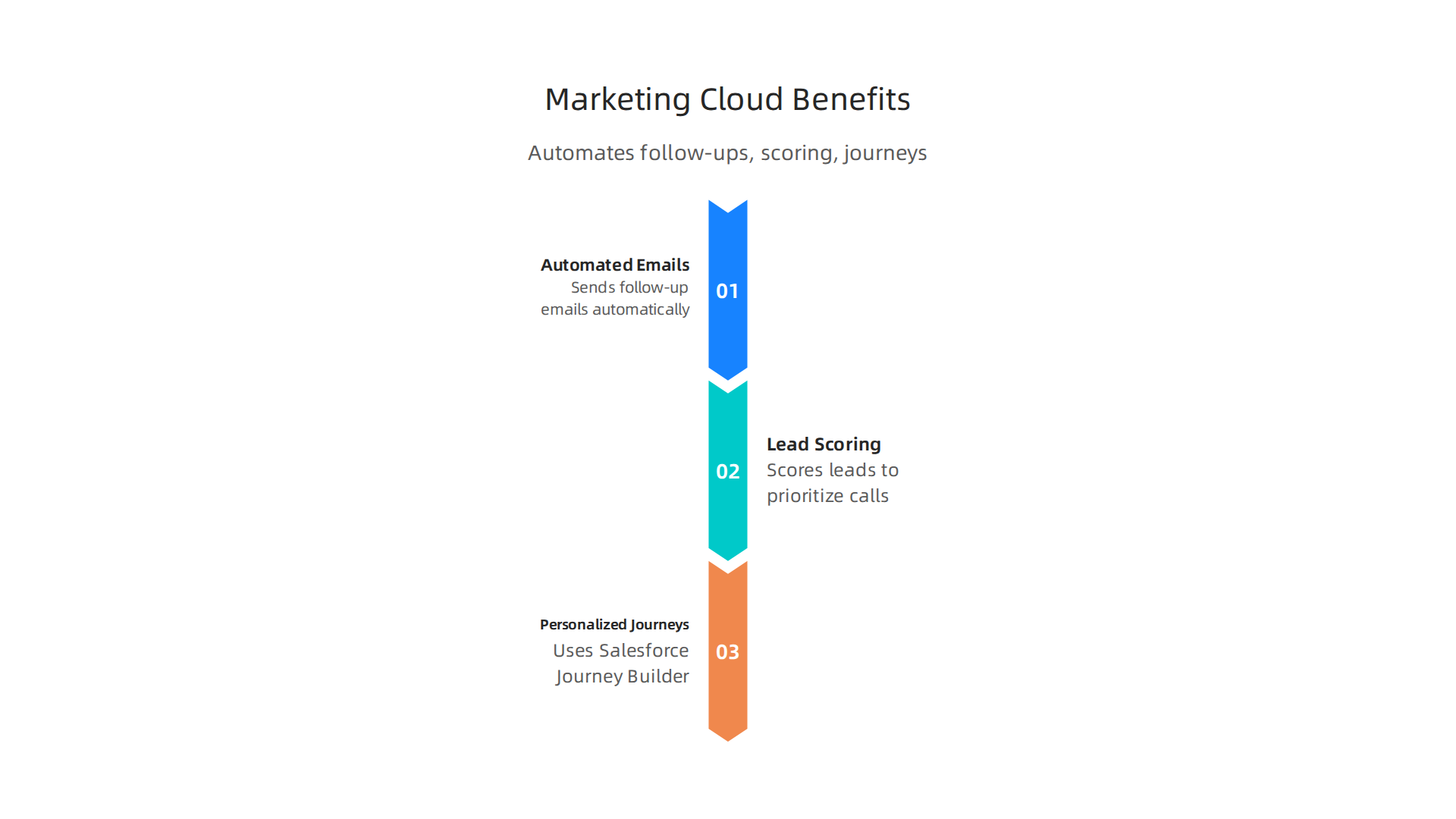
The result? Shorter sales cycles and higher conversion rates without you working harder.
But the real win is cutting through information overload. You probably get dozens of alerts every day. Emails. Notifications. Reports. It is exhausting. Marketing Cloud filters the noise and shows you what actually matters. No more guessing which lead is ready to buy.
The ROI is clear too. Companies using AI powered workflows report average productivity gains of 30%. That kind of efficiency helps you justify the investment to your boss or your stakeholders. It turns a cost into a profit driver.
Of course, tools only work when you have the right skills to use them. That is why pairing technical knowledge with strong human abilities matters. You can build on that foundation with targeted training through soft skills training that boosts sales performance and roi. Because the best tech in the world still needs a skilled person behind it.
Marketing Cloud gives you the system. Your skills give you the edge. Together they create the consistency you have been looking for.
The Real Cost of Inconsistent Sales Performance
Inconsistent performance is not just frustrating. It has a real price tag. When you cannot predict your results, your income swings wildly. One month you crush it. The next you barely make quota. That instability makes it hard to plan your finances, build a career, or earn the trust of your manager. Over time, it stalls your growth. You get passed over for promotions because your numbers look like a roller coaster.
So what causes the inconsistency? Two big culprits keep coming up. First, objection overload. You hear the same pushback again and again, but you never have a reliable way to handle it. Second, a lack of confidence in your pitch. You second guess yourself, hesitate, and lose momentum. These patterns make every deal feel like a gamble.
Here is where marketing cloud salesforce changes the game. It does not just automate emails. It standardizes your entire process. With tools like salesforce journey builder, you build predictable workflows that guide every prospect from first touch to close. No more flying blind. No more relying on memory or luck.
The data backs this up. According to the Salesforce Marketing Statistics report for 2026, 83% of sales teams using AI saw revenue growth, compared to just 66% of teams that did not. That gap shows how process and technology reduce variability. You get consistency, which leads to stable income and real career momentum.
But tools alone are not enough. You still need the human skills to handle objections and build confidence. That is why pairing Marketing Cloud with targeted training is so powerful. If you want to stop the income roller coaster and start building predictable results, check out sales enablement salary benchmarks for 2026 and how to earn more. It shows you exactly how consistency leads to higher earnings and career acceleration.
How Marketing Cloud Directly Addresses Sales Pain Points
You already know the two big blockers: objection overload and lack of confidence in your pitch. Marketing Cloud salesforce tackles both head on.
First, automation cuts down the manual work that eats your time. Instead of sending emails one by one or tracking leads in a spreadsheet, the platform handles repetitive tasks for you. That frees you up to focus on high value activities like building relationships and handling complex conversations. When your day is less cluttered, you have more mental energy to prepare for objections.
Second, personalization helps you overcome objections before they even come up. With tools like Salesforce Journey Builder, you can send the right message at the right time based on what a prospect has done. A guide on content personalization from Salesforce explains how tailoring your outreach to individual needs makes your pitch feel less like a script and more like a solution. When a prospect sees that you understand their specific situation, the usual pushback melts away.
Third, the platform includes built in training resources that address confidence gaps. Many teams use Marketing Cloud to deliver micro learning modules right inside the workflow. You can practice objection handling and review best practices without leaving your desk. Pairing that with dedicated soft skills training that boosts sales performance and ROI gives you the human edge technology cannot replace.
The result? Less guesswork, more stability. You stop reacting to every problem and start leading the conversation with confidence.
Key Marketing Cloud Features for Sales Enablement
Now that you see how marketing cloud salesforce solves those pain points, let us look at the specific tools that do the heavy lifting. The core platform includes well known tools like Salesforce Journey Builder, Email Studio, and Automation Studio.
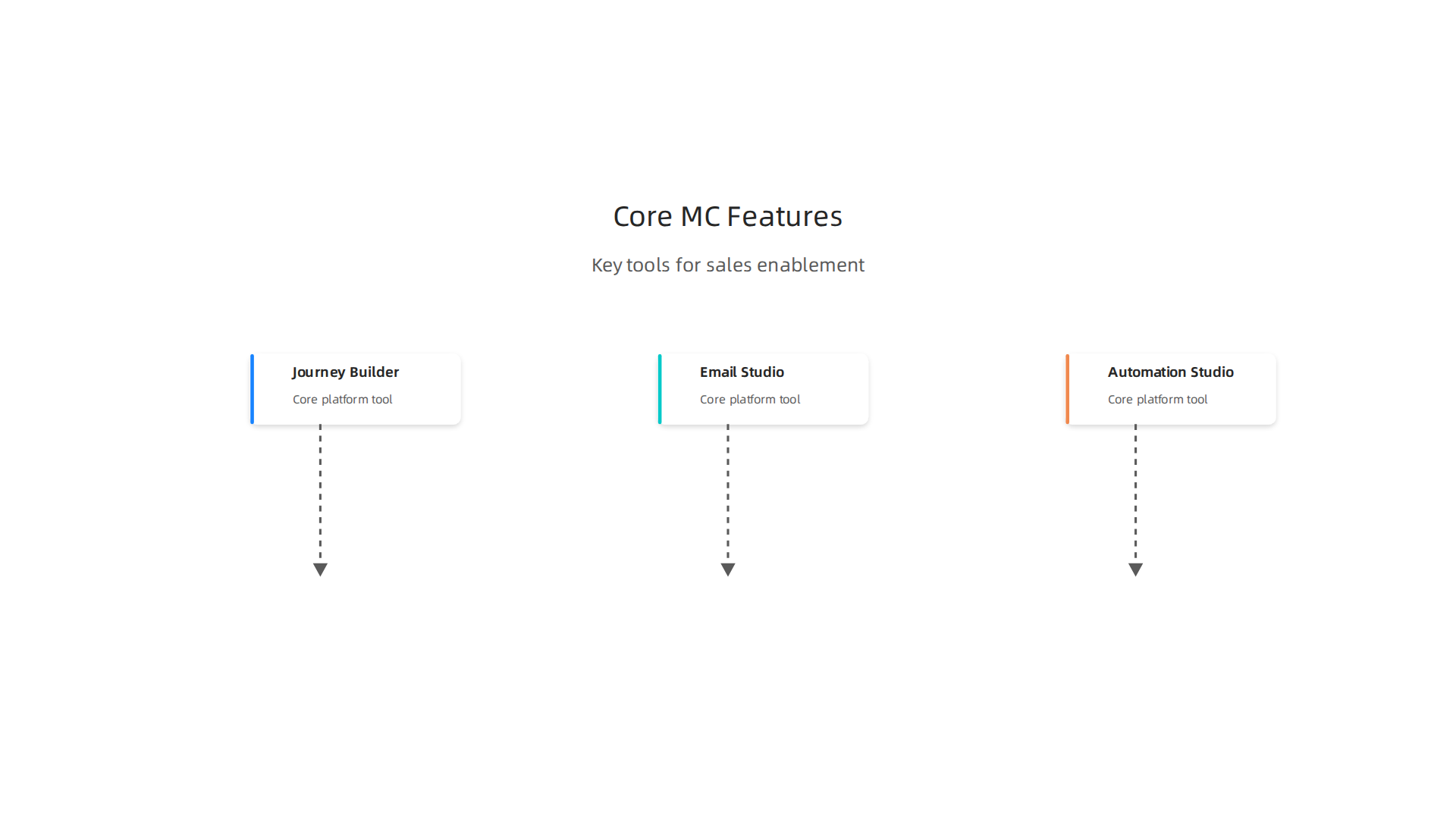
A detailed breakdown of these Marketing Cloud features from igmGuru shows how each one plays a unique role in your workflow.
These tools directly support sales by automating lead nurturing and outreach. For example, Journey Builder lets you map out the exact path a prospect follows. You send the right email at the right moment without manual work. The 2026 updates to the platform, including the rise of Agentic Marketing, make these automated journeys smarter by using AI to predict the next best action. You can explore the full capability on the official Marketing Software by Salesforce Marketing Cloud page.
But here is the real trick. You do not need to turn on every feature at once. Choosing the right feature stack depends entirely on your team size and maturity. A small team might start with just Email Studio. A larger operation unlocks more value from Automation Studio and Data Cloud. If you are unsure what matches your current stage, a guide on how to choose the best CRM software can help you build your tech stack the smart way.
Journey Builder: Automated Lead Nurturing That Converts
Let us zoom in on the feature that ties your entire marketing cloud salesforce strategy together: Salesforce Journey Builder. Think of it as your automated sales assistant that works around the clock.
Instead of manually moving leads through spreadsheets, you build a visual map. When a lead enters, Journey Builder checks their behavior.

Did they open the email? Send them a case study. Did they visit the pricing page? Alert a sales rep. These automated triggers mean the right message goes out at exactly the right moment. The 2026 updates to the platform, including Agentic Marketing capabilities, make this even smarter. The system predicts the next best action without you lifting a finger.
The real win for sales enablement? This tool connects directly to your Salesforce Sales Cloud environment. Your reps see a complete timeline of every interaction before they pick up the phone. They know exactly what the prospect cares about. No more cold calls. These are warm, informed conversations.
All of this automation gives your team breathing room. Instead of chasing emails, they can focus on high-value skills. Check out this guide on soft skills training that boosts sales performance and ROI to see how your reps can turn those warm leads into closed deals.
Email Studio: Personalization at Scale
Once a lead enters your automated journey, the next big question is: what do they actually see? With marketing cloud salesforce, the answer changes for every single person. That is the magic of Email Studio.
In 2026, Email Studio is built for sales teams who need real results. You can use updated A/B testing features to test subject lines, images, and send times. You stop guessing and start knowing what works.
Segment-based personalization changes the game. A cold lead might get a helpful guide. A warm lead who visited your pricing page might get a direct case study showing ROI. This level of targeting is easy to set up using core Salesforce Marketing Cloud features like Data Extensions. The result is higher engagement and stronger reply rates.
The Salesforce Sales Cloud connection makes all this data useful for your reps. They see real-time performance data right inside their CRM. They know who clicked, who opened, and who is ready to have a real conversation. This turns the what is salesforce question into a very clear answer: it is a tool that helps you sell smarter.
Pairing this content engine with the Salesforce Sales Cloud integration creates a unified sales machine. Your crm software salesforce setup then works seamlessly across teams. And when you combine that automation with strong soft skills training, your team closes more deals naturally.
Automation Studio: Streamlining Repetitive Tasks
Have you ever watched your sales team spend half their day just moving data? Uploading lists, running reports, or sending the same email over and over again. That is where Automation Studio comes in. Inside marketing cloud salesforce, this tool handles all those boring jobs for you.
Automation Studio takes care of data imports, audience segmentation, and complex triggers. You set up a rule once, and it runs on autopilot.

For example, a trigger automatically sends a welcome series the moment someone signs up. Another trigger updates your CRM when a lead reaches a certain score. These are exactly the kind of marketing cloud features that save hours every week.
The biggest win? Your reps stop being data clerks and start building relationships. They can focus on real conversations instead of clicking through tabs. This is especially helpful for small teams with limited headcount. One person can manage what used to take three.
Pair this with salesforce journey builder to create deeper, automated paths. And if you want to see how the right crm software salesforce setup can scale your whole team, check out our guide on choosing the best CRM software for sales growth. It makes building your automation engine a lot simpler.
Data-Driven Personalization and Sales-Marketing Alignment
Having more free time is great. But the real magic happens when you use that time to personalize your outreach. When you send a message that shows you truly understand a prospect’s problem, your conversion rates go up. Great marketing personalization starts with great data.
That is where alignment comes in. When sales and marketing share the same customer data and goals, everyone wins. Your marketing team sends leads who are warmed up and ready to talk. Your sales team knows exactly what story to tell next.
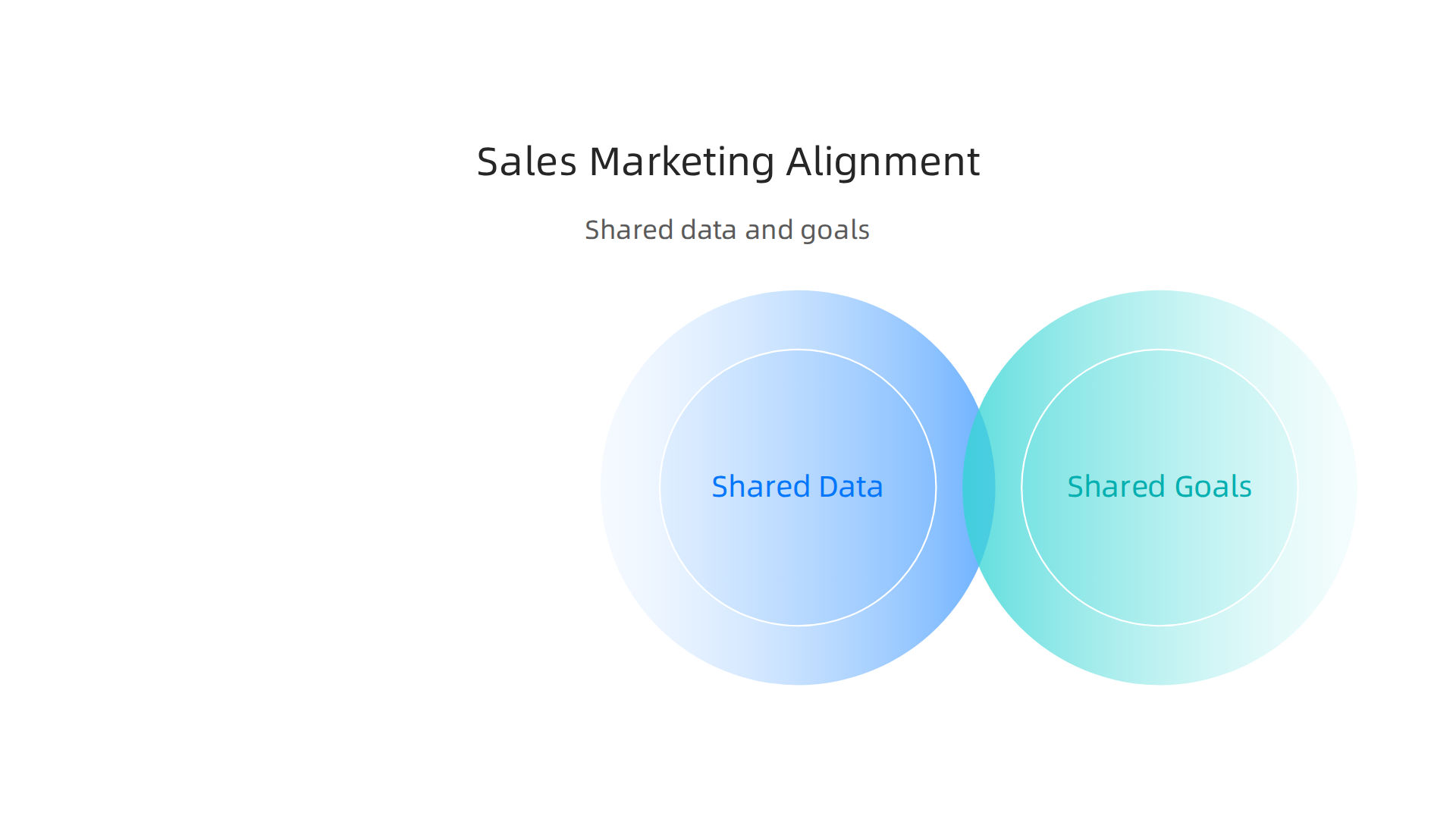
This is a core part of a strong sales and marketing alignment strategy.
Marketing cloud salesforce is the engine that makes this possible. It acts as the single source of truth for both teams. Your salesforce journey builder can then use that data to create a smooth handoff from marketing to sales. The result is a consistent message that builds trust at every step.
If you are ready to build this kind of unified system, you need the right foundation. Read our guide on choosing the best CRM software for sales growth to see how the right platform brings your teams together.
Leveraging Customer Data for Smarter Outreach
You already have a goldmine of information about your prospects. The key is to collect that data and use it to send the right message at the right time.
Start by gathering behavioral data from your website, email campaigns, and CRM system. When a prospect visits your pricing page three times and opens every email, that tells you something. Great marketing personalization starts with getting your data in order.
Next, use predictive scoring to prioritize leads. Your marketing cloud salesforce platform can automatically assign scores based on actions. High-intent leads rise to the top so your sales team knows who to call first. If your setup isn’t doing this, you might want to check for signs your Salesforce Marketing Cloud needs consulting.
Then, segment your audiences for hyper-personalized messaging. With salesforce journey builder, you create different paths for different buyer types. A first-time visitor gets a different email than a repeat buyer. This tailoring makes your outreach feel human. Content personalization is about tailoring messages based on individual preferences.
By combining behavioral data, scoring, and segmentation, your crm software salesforce becomes a powerful engine for smarter outreach.
Ready to set up a CRM that handles this? Check out our guide on choosing the best CRM software for sales growth.
Building a Unified Sales-Marketing Strategy
You’ve got great data and personalized outreach. But if your sales and marketing teams aren’t on the same page, all that effort can go to waste. A unified strategy turns your marketing cloud salesforce into a bridge between the two groups.
Start with shared KPIs and dashboards. When both teams see the same numbers, they focus on the same goals. For example, track metrics like lead conversion rate and pipeline value in one place. Marketing ROI guides from Salesforce show how aligning on these numbers improves performance. Actually, enterprise companies that use marketing cloud salesforce see an average ROI of 299% over three years, according to data integration ROI statistics. That kind of growth comes from teams that work together, not against each other.
Next, automate lead handoffs. When marketing qualifies a lead, it should instantly appear in your crm software salesforce for the sales team. No manual emails. No lost opportunities. With salesforce sales cloud, you can set up automated triggers that pass hot leads straight to the right rep. This cuts response time and keeps the momentum alive.
Finally, make regular communication a habit. Use shared dashboards in salesforce journey builder to review campaign performance together. Marketing can show what messaging works, and sales can share feedback from the front lines. Marketing statistics for 2026 highlight that companies with strong sales-marketing alignment are more likely to hit revenue targets. Simple weekly check-ins can make a huge difference.
Building this unified approach doesn’t have to be hard. Start with clear goals and the right tools. For more on creating a predictable sales system, check out our guide on management right sales: the proven system for predictable growth.
Implementation and ROI: Practical Steps for Small Teams
If you’re a small team, jumping into marketing cloud salesforce might feel overwhelming. But here’s the good news: you can start small and scale up as you grow.
First, pick a low-cost entry point. Salesforce offers the Starter Suite starting at just $25 per user per month, according to a Salesforce Small Business pricing guide. That gives you basic CRM and marketing features without a big upfront investment. For teams wanting more focused marketing power, the Marketing Cloud Growth Edition costs $1,500 per organization per month. That’s a smart option if email automation is your main priority.
Second, go after immediate wins. Start with email automation using salesforce journey builder. Set up a simple welcome series or a follow-up sequence for new leads. Once you see results, you can expand into more complex campaigns. This builds confidence and shows quick value to your team.
Finally, measure your ROI to secure future budget. Track simple numbers like cost per lead, conversion rate, and revenue generated. When you can show that your crm software salesforce investment is paying off, asking for a bigger budget next quarter gets a lot easier.
Want to see how these tools fit into a complete sales system? Check out our guide on choosing the best CRM software for more tips.
Affordable Implementation Strategies (Even on a Tight Budget)
You don’t need a big budget to start with marketing cloud salesforce. Actually, the smartest way is to try before you buy. Salesforce offers a free trial of Marketing Cloud, so you can test email automation and salesforce journey builder without any risk. Start with a small Email Studio pilot: send a few targeted campaigns to a segment of your list. That lets you see real results before committing to a paid plan.
Another way to save money? Use pre-built templates and quick start packages. Salesforce provides readymade email templates and campaign flows that cut down setup time and cost. Instead of building from scratch, you can launch your first campaign in days, not weeks.
If your team lacks in-house Salesforce skills, consider partnering with a certified implementation partner. They guide you through the setup, avoid costly mistakes, and help you get the most out of the platform. This can actually reduce your total cost in the long run. According to a Salesforce implementation cost guide, professional implementation for small businesses typically starts around $10,000, but the ROI from a properly configured system makes it worthwhile.
Once your marketing automation is running, you’ll want your team to use it effectively. That’s where proper training comes in. Check out our guide on how an LMS corporate training platform solves your biggest sales training challenges to see how you can upskill your team without breaking the bank.
Key Metrics to Track and How to Demonstrate ROI
You’ve set up your marketing cloud salesforce on a budget. But how do you prove it’s working? The numbers don’t lie. You need to track three key metrics: conversion rate, pipeline velocity, and cost per lead.
Conversion rate tells you how many people take the action you want. Pipeline velocity shows how fast leads move through your sales cycle. Cost per lead reveals how efficiently you’re spending. These three give you a complete picture. According to Salesforce’s ROI guide, calculating marketing ROI starts with understanding how your activities drive revenue.
The good news? You don’t need to build reports by hand. Marketing Cloud has built-in automated dashboards that pull your data in real time. This makes it simple to show management exactly where the value is. A study from Absyz confirms that Marketing Cloud Analytics helps measure and enhance ROI through these very tools.
Here’s the trick that many miss. Align your metrics with sales compensation. When sales reps see that their commissions depend on the same leads your campaigns generate, everyone starts paying attention. This connection between what is salesforce and real revenue is what makes the system work.
If you want to dig deeper into how to structure your sales roles for maximum ROI, check out our guide on sales enablement salary benchmarks for 2026 and how to earn more. It connects the dots between your marketing data and your team’s financial success.
Conclusion: Your Next Steps with Marketing Cloud Salesforce
Marketing Cloud is not just a marketing tool. It is a sales accelerator. When your email campaigns, lead scoring, and journey automations feed directly into your sales process, you stop wasting time on cold leads. You start closing more deals. That is the real payoff of using marketing cloud salesforce the right way.
So what do you do next? Start small. Pick one customer group and build a focused flow in salesforce journey builder. Do not try to connect every system at once. Test your automations. Look at the data. Then grow from there. A slow and steady start beats a broken big launch every time. If your setup starts to feel messy, it might be time to look for signs your Marketing Cloud needs expert help before you scale.
Next, invest in your people. Your team needs to know how this crm software salesforce system works. They also need to understand what is salesforce and how it connects marketing activities to real revenue. When your sales reps see warm leads coming from a well built journey, they will trust the system. Aligning your sales and marketing teams around shared goals is a game changer. Check out this guide on Sales and Marketing Alignment from Salesforce for a clear path forward.
Finally, keep learning. The platform changes fast. So do buyer behaviors. If you want to build a high performing sales team that knows how to leverage tools like salesforce sales cloud for maximum profit, explore our guide on sales enablement salary benchmarks for 2026 and how to earn more. It helps you understand the talent you need to run your systems effectively.
Your next steps are simple. Start focused. Train your people. Align your teams. Do these three things, and your investment in Marketing Cloud will deliver real revenue growth in 2026.
Summary
This article explains how Salesforce Marketing Cloud turns inconsistent sales results into predictable revenue by combining automation, personalization, and smart data use. It walks through the core features — Journey Builder, Email Studio, and Automation Studio — and shows how each speeds lead nurturing, reduces manual work, and surfaces the highest-value prospects. You’ll learn how to use behavioral data and predictive scoring to prioritize leads, how to align sales and marketing with shared KPIs and automated handoffs, and which features to roll out first if you’re a small team. The guide also covers affordable implementation options, practical ROI metrics to track, and simple steps to launch a pilot that proves value before scaling. Overall, the article gives a clear playbook for starting small, training your team, and building a unified system that delivers repeatable sales performance.
Category
Salesforce Marketing Cloud
Written by

Published
May 6, 2026
More from the blog
Related reading





Next steps
Put the ideas from this article into practice
Explore related posts on the blog or reach out if you need a specific resource.

Sales Closing Course is a specialized affiliate content website focused on helping people learn and improve sales closing skills. The site publishes high-quality content about sales closing techniques, high-ticket sales training, objection handling, communication skills, closing frameworks, income p